House GOP revolt forces vote on ACA subsidies
The new health care bill would lower some costs but not extend expiring Affordable Care Act subsidies


What happened
The House Wednesday night passed a health care bill proposed by Speaker Mike Johnson (R-La.) that would lower some costs modestly but not extend expiring Affordable Care Act subsidies. Defying Johnson, four of the Republicans who pushed his bill to its narrow 216-211 passage also signed a discharge petition Wednesday, clinching the 218 signatures needed to force a vote on a Democratic proposal to extend the subsidies for three years.
Who said what
Several politically vulnerable Republicans had pushed Johnson to allow a vote on their proposals to extend the ACA credits for a year or two, with new limits, to avert a sharp rise in premiums for 24 million Americans in January. “But with most Republicans opposed to the subsidies, Johnson refused to allow an extension in his bill, fomenting the strongest rebellion among Republicans from swing districts to date,” The Washington Post said.
“To me, the clean three-year extension is not ideal,” said Rep. Michael Lawler (R-N.Y.), one of the four Republicans who signed the Democrats’ petition. “But doing nothing is not an answer.” Johnson “forced this outcome,” said fellow moderate rebel Rep. Brian Fitzpatrick (R-Pa.).
The “stunning maneuver” by the House GOP “splinter group” was “all but guaranteed to prolong Republican infighting over health care, an issue that has bedeviled the party for years, into a midterm election year” with “considerable headwinds,” The New York Times said. It was also the “latest evidence” that Johnson’s “grip on his fractious majority has slipped” as “rank-and-file Republicans openly question his leadership and flout his wishes,” advancing four “once rare” discharge petitions, a feat last achieved in 1938. “I have not lost control of the House,” Johnson told reporters Wednesday.
What next?
Johnson’s bill “is dead on arrival in the Senate and will do little to quell a major intraparty split over the future of the subsidies,” Politico said. Senate GOP leaders say the three-year extension, if it passes the House next month, is also “doomed to die” in the upper chamber, but “House GOP moderates are now discussing options with their Senate counterparts about a bipartisan compromise bill that could pass both chambers” before the end of January, after the subsidies have lapsed.
The Week
Escape your echo chamber. Get the facts behind the news, plus analysis from multiple perspectives.

Sign up for The Week's Free Newsletters
From our morning news briefing to a weekly Good News Newsletter, get the best of The Week delivered directly to your inbox.
From our morning news briefing to a weekly Good News Newsletter, get the best of The Week delivered directly to your inbox.

-
 What to watch out for at the Winter Olympics
The Explainer Family dynasties, Ice agents and unlikely heroes are expected at the tournament
-
 Properties of the week: houses near spectacular coastal walks
The Week Recommends Featuring homes in Cornwall, Devon and Northumberland
-
 Will Beatrice and Eugenie be dragged into the Epstein scandal?
Talking Point The latest slew of embarrassing emails from Fergie to the notorious sex offender have put her daughters in a deeply uncomfortable position


-
 A running list of everything Donald Trump’s administration, including the president, has said about his health
In Depth Some in the White House have claimed Trump has near-superhuman abilities
-
 Trump sues IRS for $10B over tax record leaks
Speed Read The president is claiming ‘reputational and financial harm’ from leaks of his tax information between 2018 and 2020
-
 Trump, Senate Democrats reach DHS funding deal
Speed Read The deal will fund most of the government through September and the Department of Homeland Security for two weeks
-
 Fed holds rates steady, bucking Trump pressure
Speed Read The Federal Reserve voted to keep its benchmark interest rate unchanged
-
 Judge slams ICE violations amid growing backlash
Speed Read ‘ICE is not a law unto itself,’ said a federal judge after the agency violated at least 96 court orders
-
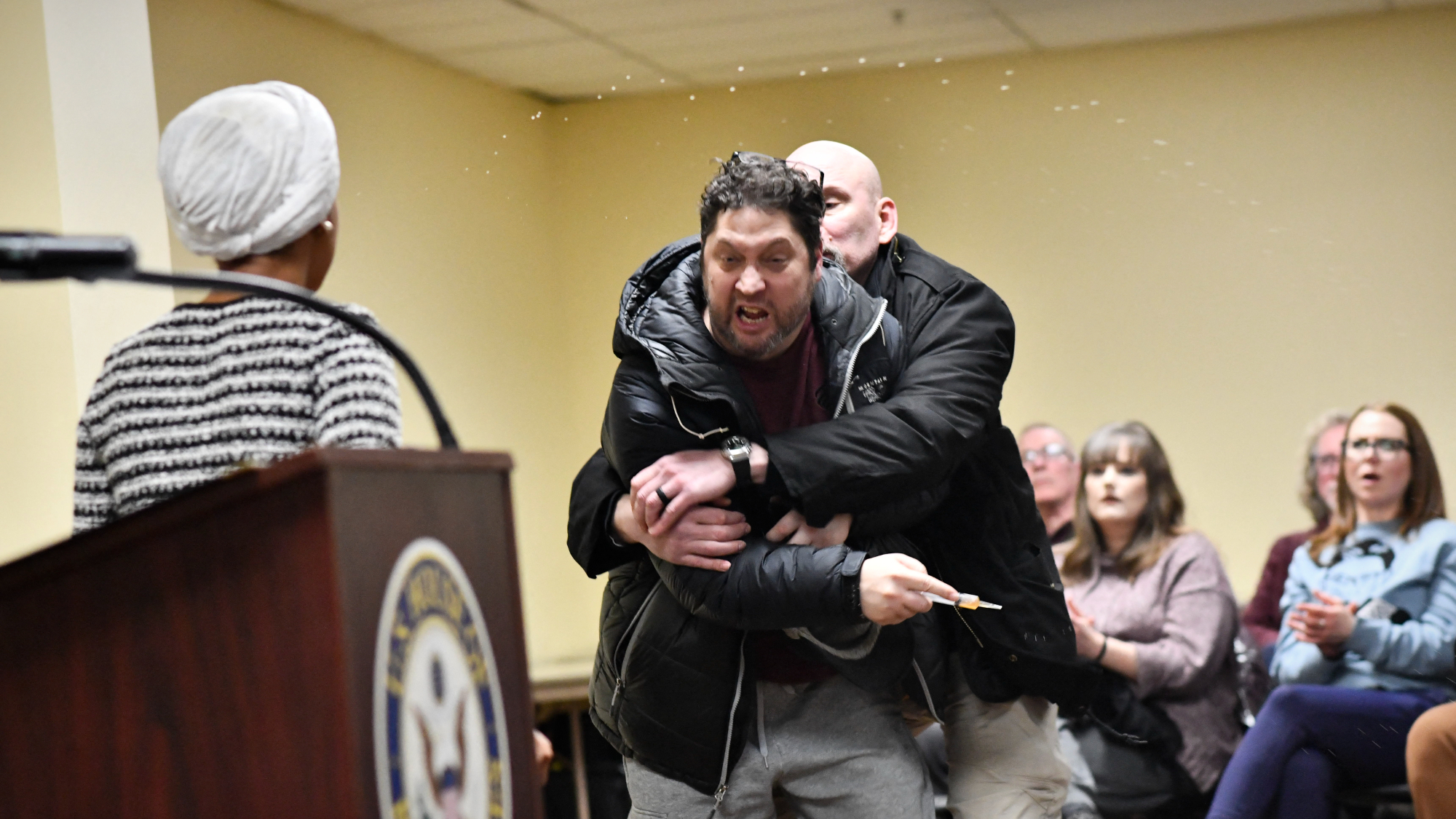 Rep. Ilhan Omar attacked with unknown liquid
Speed Read This ‘small agitator isn’t going to intimidate me from doing my work’
-
 Democrats pledge Noem impeachment if not fired
Speed Read Trump is publicly defending the Homeland Security secretary
-
 Is Alex Pretti shooting a turning point for Trump?
Today’s Big Question Death of nurse at the hands of Ice officers could be ‘crucial’ moment for America


